Mastering Deception with EV
How Perry Husband's Effective Velocity Theory is Revolutionizing Pitching Performance
Pitching.Dev
8/7/20259 min read
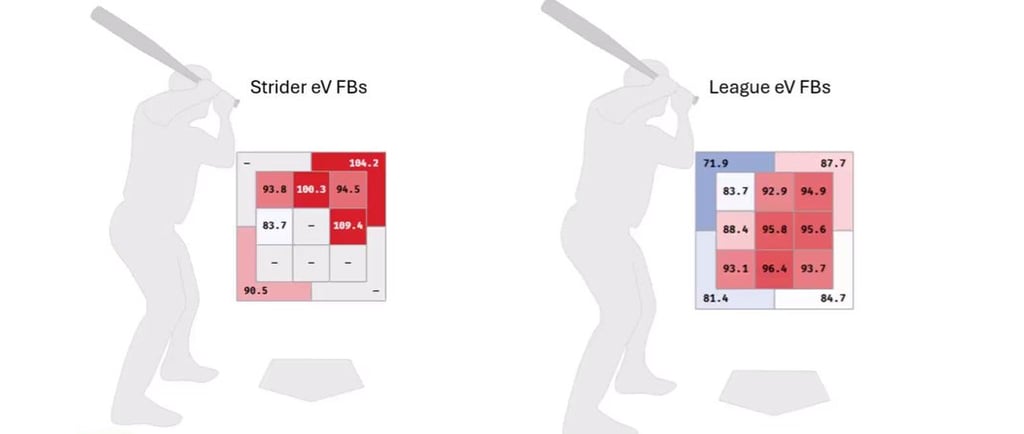
In the ever-evolving world of baseball analytics, few concepts have generated as much discussion—and success—as Perry Husband's Effective Velocity (EV) theory. This revolutionary approach to pitching has been credited with helping teams like the World Series Champion Texas Rangers and the Houston Astros transform their pitching staffs from worst to first, yet it remains one of the most misunderstood concepts in modern baseball.
While traditional baseball metrics focus on raw velocity readings from radar guns, Effective Velocity digs deeper into the psychological and physiological realities of hitting. The theory suggests that "speed is super relative" and that "every place in the strike zone has a place that it needs to be hit, where I have to get extended to get there"—fundamentally challenging how we think about pitch speed and sequencing.
The Visionary Behind the Theory
Perry Husband didn't set out to revolutionize pitching when he began his research over two decades ago. His journey into Effective Velocity began with an unusual experience in men's fast-pitch softball, where he faced a pitcher throwing about 80 MPH from 46 feet. This experience, where the reaction time was dramatically reduced compared to baseball, sparked his curiosity about how location and timing affect a hitter's ability to make contact.
Husband patented the science of Effective Velocity and has worked with countless NCAA champions, credited for helping the Astros win the National League Championship in 2005. His work extends beyond just pitching theory—he was also instrumental in introducing concepts like Exit Velocity and Launch Angle to baseball, metrics that are now standard in player evaluation.
Understanding the Core Principle: Location Adjusted Speed
At its foundation, Effective Velocity is about 'Location Adjusted Speed' (EvMPH), meaning the true reactionary speed is affected by simply changing location. This isn't just theoretical—it's based on the physical reality of how hitters must adjust their swing mechanics based on where they need to make contact.
The concept hinges on response time and the arc of hitters' swings, with the understanding that bats must move farther to reach pitches on the inner part of the plate than on the outside edge. When a pitcher throws to different locations, they're not just changing where the ball crosses the plate—they're fundamentally altering when and how a hitter must react.
Consider this: a batter can hit an outside fastball as it crosses the plate, but to make solid contact with an inside fastball, he must reach it much sooner—up to 2 feet in front of the plate—which requires the hitter to move the bat a greater distance in less time. This creates an "effective" velocity that differs from what the radar gun reads.
The Mathematics of Deception
The Effective Velocity model assigns specific adjustments to pitch locations. A pitch up and inside might be perceived as 7-8 mph faster than its actual velocity, while a pitch down and away might be perceived as several mph slower. These adjustments aren't arbitrary—they're based on extensive testing and biomechanical analysis of how hitters respond to different pitch locations.
A fastball thrown at 93 MPH but located in an area that causes it to lose 3-5 EvMPH effectively becomes a 90 EvMPH pitch to the hitter. This revelation has profound implications for how pitchers should approach their craft. What good is gaining velocity if you're wasting it by locating pitches in areas that negate that advantage?
The Hitter's Attention Zone
One of Husband's most significant discoveries is what he calls the "Attention Zone"—the speed range where hitters are most focused and produce the best results, typically around 92 to 87 EV miles per hour. Big league hitters have about a six-mile-an-hour speed range where they produce at a high level, and this attention zone is where all the hard-hit balls happen—it's the peak of all hitting statistics.
This discovery explains why simply throwing harder isn't always the answer. If a pitcher's "plus" velocity falls directly into a hitter's attention zone, they may actually be making themselves more hittable. Understanding this concept allows pitchers to strategically place their velocities outside these danger zones through smart sequencing and location.
EV Tunnels: The Art of Visual Deception
Perhaps the most revolutionary aspect of Effective Velocity is the concept of "EV Tunnels." Pitch Tunnels were designed to create the latest pitch identification point possible, delaying identification to make hitters struggle to adjust to speed differentials.
Husband's theory on 'Pitch Tunneling' is centered on that every hitter must decide to swing no later than the first 20 ft. a pitch is in the air. By making different pitches follow identical trajectories for this crucial period, pitchers can hide their true intentions until it's too late for hitters to adjust.
EV Tunnels create an illusion of a middle fastball, while actually moving to the fastest area of the zone. Off speed 'appears' to be a fastball middle but moves to a slower place in the zone. Every tunnel pitch is a lie because the tunnel is a lie. This isn't just about throwing strikes—it's about manipulating the hitter's perception and timing.
Real-World Implementation and Success Stories
The practical applications of Effective Velocity have produced remarkable results at the highest levels of baseball. Brent Strom took the Astros from 30th in pitching to 1st in 2 years utilizing Effective Velocity as his "Go To" when designing pitcher's arsenals. This transformation wasn't just about finding better players—it was about maximizing the effectiveness of existing talent through smarter pitch sequencing and design.
The Texas Rangers and Arizona Diamondbacks used the Effective Velocity Microscope to create advanced game plans that changed the course of the 2023 Postseason leading to the World Series. These weren't just theoretical applications—they were game-changing strategies implemented at the sport's highest level.
The case of Mariano Rivera provides a perfect example of EV principles in action. Without EvMPH changes, Mo's career accomplishments would simply be impossible using primarily cut fastballs alone. When pitchers learn Ev 101, they can dominate hitters with one tool, imagine what happens with 4 tools maximized.
Scientific Pitch Sequencing
Traditional pitch sequencing often relies on "feel" or conventional wisdom. Effective Velocity transforms this into what Husband calls "the only scientific pitch sequencing methodology". This approach isn't about randomly mixing speeds and locations—it's about understanding exactly how each pitch affects the hitter's timing and perception.
To become a Black Belt in Effective Velocity, you have to (1) Eliminate Predictability (2) Maximize Deception (3) Create Maximum EvMPH Speed Differentials (4) Learn to Sequence Pitches Scientifically.
The power of this approach becomes evident when examining hard contact data. Research shows that 50% of all hard contact occurs when pitches are within 6 EvMPH of each other, while only 10% occurs when pitches are properly sequenced with appropriate EV differentials. This means that 90% of all hard contact is preventable through proper EV sequencing.
Practical Application for Modern Pitchers
For pitchers looking to implement EV principles, the process begins with understanding their own arsenal through the EV lens. This means:
Mapping Your EV Profile: Every pitch in different locations has an effective velocity. A 92 MPH fastball up and in might play like 95-96 EV, while the same pitch down and away might play like 88-89 EV. Understanding these variations allows pitchers to create strategic sequences.
Building EV Tunnels: Pitchers can design their sequences to ensure that different types of pitches follow similar trajectories for the majority of their path to the plate. For example, a fastball and a changeup might be thrown in such a way that they appear identical to the hitter until the final moments before reaching the plate.
Maximizing Speed Differentials: It's not just about the difference in actual velocity—it's about the difference in effective velocity. A 92 MPH fastball up and in followed by an 82 MPH changeup down and away creates a much larger EV differential than the 10 MPH actual difference suggests.
Training EV Recognition: The iPhone is a tremendous tool—it records video at 120 frames per second, allowing anyone to break down their mechanics and their pitches frame by frame! Recording from behind the pitcher's head and behind the catcher provides valuable information about how each pitch will look to lefties and righties, its downward angle, and break of the pitch.
The Debate and Evolution
Not everyone in the baseball community has embraced Effective Velocity without question. Driveline Baseball conducted a thorough analysis using 2015-2018 MLB pitch-level data and found little evidence supporting EV Theory's claims. They noted that "many aspects within the game of baseball have changed in the 15+ years since Husband first researched EV theory. Since pitchers can now throw the ball harder than ever, and batters are better equipped to handle the heat, perhaps it is not so surprising that relationships between batter production and Effective Velocity have changed significantly".
However, critics of the Driveline study point out that "a key mistake in running correlational studies for the effectiveness of EV-diff. is to leave out tunneling, which is indeed what happened in Driveline's research". This highlights the complexity of properly testing EV theory—it's not just about isolated pitch characteristics, but about the complete sequencing approach.
Recent independent university studies have actually validated core EV principles, proving that timing stats do peak at one EvMPH, and that there was a 6 EvMPH range where timing-based stats were highest, with a fairly sharp drop just beyond 3 EvMPH on either side of the peak. Interestingly, the study found that the peak has shifted from 90 EvMPH in 2004 to about 92.5 EvMPH currently, which aligns perfectly with increases in overall pitch velocity.
Advanced Applications: Liquid Analytics
Husband has evolved his thinking beyond static EV principles to what he calls "Liquid Analytics"—analytics that can be applied in real-time during games. Rather than relying on historical data that requires history to repeat itself, Liquid Analytics focuses on "doing things in the moment to win the ballgame or orchestrate a good plan for an at-bat".
This represents the next frontier in pitching strategy—not just having a pre-planned approach, but being able to adjust that approach based on real-time feedback and situational demands. As Carlos Pena noted, every team now has access to the same basic analytic information, but the 'Super Teams' have something in common—they all have very strong ties to Effective Velocity concepts.
The Future of Effective Velocity
As baseball continues to evolve, so too does the application of EV principles. One of the primary challenges associated with Effective Velocity is the inevitable adaptation of hitters. As EV principles become more widely known and understood, hitters will start to develop strategies to counteract these tactics. This ongoing evolution creates a strategic arms race between pitchers and hitters.
Hitters might work on identifying subtle differences in pitchers' delivery or release points that could indicate the type of pitch being thrown, thereby reducing the effectiveness of EV Tunnels. As hitters become more adept at recognizing and reacting to EV-influenced pitches, pitchers will need to continually evolve their approaches.
Implementing EV in Player Development
For coaches and pitchers serious about implementing EV principles, the approach must be systematic and comprehensive. It's not enough to understand the theory—successful implementation requires:
Physical Development: Pitchers need the physical capability to execute pitches to specific locations consistently. Command isn't just about strikes and balls—it's about being able to place pitches within inches of intended targets to maximize EV effects.
Mental Training: Understanding EV theory is just the beginning. Pitchers must develop the mental framework to think in terms of effective velocity rather than just radar gun readings. This includes understanding how different pitch sequences affect hitter timing and perception.
Technology Integration: Modern tools like Rapsodo and TrackMan can help pitchers understand not just their velocity profiles, but how movement patterns interact with EV principles. The key is interpreting this data through an EV lens rather than just focusing on traditional metrics.
Game Planning: EV principles should inform every aspect of game preparation, from studying opposing hitters to designing specific sequences for different counts and situations. This requires a complete shift from traditional scouting approaches.
The Broader Impact on Baseball
As Husband noted, "Any method of hitting can work now but that will come to an end when pitchers understand how to max out their pitching approaches". This suggests that we may be approaching a fundamental shift in the pitcher-hitter balance.
The implications extend beyond just professional baseball. Youth and amateur coaches who understand and implement EV principles may find their pitchers significantly more effective, even without elite velocity. This democratization of advanced pitching strategy could reshape player development at all levels.
Conclusion: The Science of Deception
Effective Velocity represents more than just another analytical tool—it's a fundamental reimagining of how pitching works. By understanding that perception is reality for hitters, and that location affects timing as much as velocity affects swing decisions, pitchers gain access to a level of deception previously thought to be innate talent.
As Bill James told a SABR Analytics Convention audience, if you want to change the game, you have to ask 'Big' questions. Perry asked the biggest question of all: what causes hard hit balls? Effective Velocity answers that question using real 'Science'.
The beauty of EV theory lies not just in its sophistication, but in its practical applicability. Whether you're a major league pitcher looking to maximize your four-pitch arsenal or a high school player working with basic velocity, understanding how location affects timing and perception can transform your effectiveness on the mound.
As baseball continues its analytical evolution, Effective Velocity stands as proof that the most powerful insights often come not from new technology, but from asking better questions about the game's fundamental dynamics. In a sport where inches and milliseconds determine success and failure, understanding how to manipulate a hitter's perception of time and speed represents the ultimate competitive advantage.
The question isn't whether Effective Velocity will continue to influence baseball—it's how quickly pitchers and coaches will embrace its principles to unlock their full potential on the mound. In a game where deception has always been an art, Perry Husband has provided the science to perfect it.