Seam Shifted Wake
The Revolutionary Science Behind Baseball's Next Frontier
8/7/20258 min read
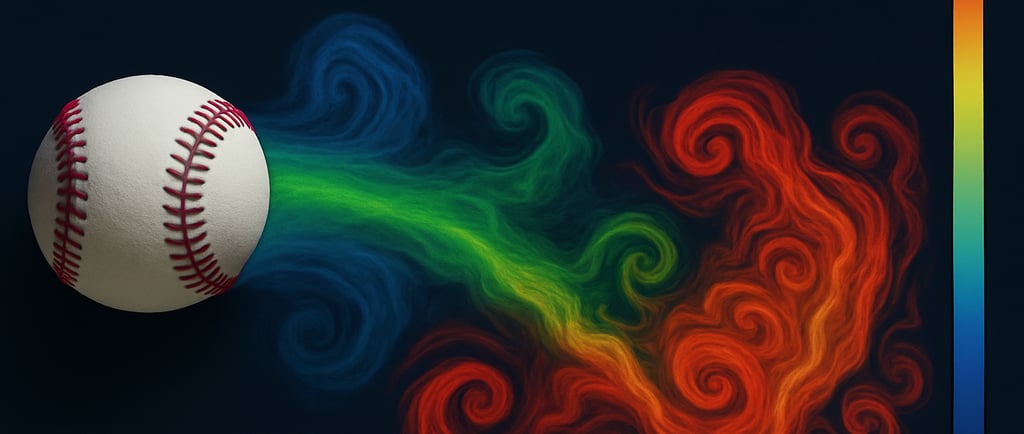

How Dr. Barton Smith's groundbreaking research is changing our understanding of pitch movement and transforming baseball forever
For over a century, baseball has been a sport governed by tradition, intuition, and an evolving understanding of physics. Pitchers have long known that certain grips produced different movement, but the why behind this phenomenon remained largely mysterious. That changed dramatically with the pioneering research of Dr. Barton Smith, a mechanical and aerospace engineering professor at Utah State University, whose work on seam shifted wake has fundamentally altered our understanding of how baseballs move through the air.
Beyond the Magnus Effect: A New Frontier in Baseball Physics
To understand the revolutionary nature of Smith's discoveries, we must first appreciate what came before. For decades, baseball analysts and physicists explained pitch movement primarily through the Magnus effect, first described in 1853. This well-established principle explains how a spinning ball creates differential air pressure, causing it to curve perpendicular to its spin axis. Curveballs break downward, sliders move glove-side, and four-seam fastballs generate upward lift—all thanks to Magnus forces.
However, Smith's research has revealed that this traditional understanding, while accurate, was incomplete. Working alongside his students Andrew Smith (no relation) and John Garrett, Dr. Smith discovered a separate, independent force affecting baseball trajectory: the seam shifted wake effect.
The term "seam shifted wake" itself was coined by Andrew Smith during his graduate work under Dr. Barton Smith's supervision. This phenomenon occurs when the raised seams of a baseball, positioned in specific orientations relative to the ball's flight path, cause the boundary layer to separate earlier on one side of the ball than the other, creating an asymmetric wake and generating forces that move the ball in directions that cannot be explained by spin alone.
The Laboratory That Changed Everything
Dr. Smith's breakthrough research employed sophisticated experimental techniques, including Particle Image Velocimetry (PIV) to examine the velocity field around baseballs in specific orientations. This technology allowed his team to identify the exact location where the boundary layer separates from the baseball's surface—the critical point where the wake begins to form.
The methodology was as rigorous as it was innovative. Smith's team launched baseballs at 90 mph with spin rates near 1200 RPM over a realistic pitching distance of 55 feet, using specialized equipment to maintain precise control over seam orientation. These pitches featured vertical spin axes perpendicular to the initial flight direction, and the results were tracked using a Rapsodo 1.0 system.
What they discovered was remarkable. When seams were positioned asymmetrically relative to the airflow, certain orientations could advance the separation point on one side of the baseball, generating pressure forces that modified the ball's flight path in ways completely independent of Magnus-induced movement. The ball would literally move away from the side with prominent seams, creating movement patterns that defied traditional explanations.
Perhaps most significantly, Smith's research demonstrated that this effect was more pronounced with baseballs featuring larger seams, suggesting that the physical characteristics of the ball itself played a crucial role in the phenomenon.
The Physics Behind the Mystery
The science of seam shifted wake is both elegant and complex. Unlike the Magnus effect, which relies on the ball's rotation to create pressure differentials, SSW depends entirely on the position and orientation of the baseball's seams relative to the airflow.
When seams are positioned in specific locations relative to the direction of the ball, they force the boundary layer to separate earlier (closer to the front of the ball) than it normally would. If this occurs on one side of the ball and not on the opposite side, a net force is created.
This phenomenon is fundamentally different from what occurs in cricket with swing bowling, where the hemispherical seam creates laminar flow on one side and turbulent flow on the other. Smith's research showed that baseball's more complex seam pattern, which has a ramp-like shape rather than small bumps, creates different aerodynamic effects. The baseball seam's most important effect is to remove the boundary layer from the side on which it resides, leading to deflection toward the seam.
From Theory to Diamond: Real-World Applications
The transition from laboratory discovery to on-field application represents one of the most exciting developments in modern baseball. While Smith and his team were conducting their groundbreaking research, similar investigations were happening in parallel at facilities like Driveline Baseball, creating a convergence of scientific understanding that would soon impact how pitches are designed and analyzed.
The story of pitcher Jared Hughes provides a perfect example of how SSW manifests in professional baseball. Hughes, a nine-year MLB veteran, had been experiencing inconsistencies with his sinker. Working with coaches, he discovered that his most effective sinkers occurred when his spin axis reached around 270-280 degrees, creating more vertical movement. When Smith's research emerged, it provided the scientific explanation for what Hughes had been experiencing empirically.
The real-world implications are profound. As Smith noted, "If you miss your mark slightly with a Magnus-dependent pitch, it moves slightly differently. If you miss your mark with seam orientation, it's utterly different." This suggests that SSW pitches may be more sensitive to execution but potentially more devastating when properly located.
The Data Revolution: Hawkeye and Observable Evidence
The introduction of MLB's Hawkeye optical tracking system in 2020 provided the missing link between Smith's laboratory discoveries and real-world evidence. Unlike previous radar-based systems that inferred spin from movement, Hawkeye cameras could directly observe spin axis orientation, revealing the extent to which seam shifted wake effects were present in major league pitching.
This new data made it clear that seam-shifted wake effects are present in most pitches. Evidence can be found by comparing spin-based movement to observed movement on MLB's databases—when these values differ significantly, it indicates the presence of non-Magnus forces, primarily SSW.
The implications for pitch analysis have been transformative. Research using this data has shown that among the top 20 pitchers with the greatest deviation between expected and actual movement, twelve were documented as throwing variations of one-seam sinkers, where one or both fingers rest on only one seam of the baseball rather than sitting between the seam tracks.
Revolutionary Impact Across Pitch Types
Smith's research has implications that extend far beyond sinkers and two-seam fastballs, though these pitches have received the most initial attention due to the pronounced nature of the SSW effect.
Sinkers and Two-Seamers: These pitches show the most dramatic SSW effects, with the phenomenon helping explain why certain sinkers generate exceptional arm-side run and vertical drop that cannot be accounted for by Magnus forces alone. The discovery has led to renewed interest in sinker usage across MLB, reversing a trend that had seen the pitch declining in popularity.
Changeups: The research has particular significance for changeups, where SSW effects may contribute to the deceptive movement that makes these pitches effective. Smith's research suggests that changeups, particularly when thrown with gyroscopic spin, can create meaningful non-Magnus movement.
Four-Seam Fastballs: Even four-seamers can benefit from SSW effects, potentially gaining extra vertical ride as well as glove-side movement depending on seam orientation.
Breaking Balls: Certain sliders experience "sweep" or arm-side movement due to seam effects, while other breaking balls may derive unexpected movement characteristics from SSW forces.
The Evolution from "Laminar Express" to Mainstream Science
The journey from fringe theory to accepted science is fascinating. Pitcher Trevor Bauer was among the first to recognize the potential of seam orientation, beginning his experimentation in 2010. He developed what he called the "Laminar Express" through trial and error, noting massive differences in pitch effectiveness based on seam positioning. In 2014-2015, working with Kyle Boddy, Bauer refined this pitch to devastating effect.
Dr. Smith and his colleagues at Utah State University made it their mission to uncover the scientific principles behind what Bauer had discovered empirically, ultimately coining the more descriptive and scientifically accurate term "Seam-Shifted Wake" to replace the somewhat misleading "Laminar Express" designation.
Methodological Rigor and Experimental Design
The strength of Smith's research lies not just in its conclusions but in its methodological rigor. Working with graduate student John Garrett, Smith conducted comprehensive experiments investigating SSW effects in both Magnus and non-Magnus directions, analyzing boundary layer separation points across a range of velocities (60, 90, and 110 MPH) and rotation rates (1300, 1800, and 2300 RPM) for spinning baseballs.
The team created detailed boundary layer separation maps to compare non-Magnus and Magnus baseball cases, providing unprecedented insight into how seam positioning affects airflow around the baseball. The research utilized two-component planar Particle Image Velocimetry (PIV) systems to generate precise air velocity vectors around baseballs in planes parallel to flow.
This level of scientific rigor transformed baseball aerodynamics from educated speculation into measurable, repeatable science.
Industry Transformation and Practical Applications
Smith's work has influenced professional baseball at the highest levels, with the researcher visiting Blue Jays Spring Training in 2020 to work with both MLB and minor league players and coaches. The practical applications extend beyond individual pitch development to fundamental changes in how teams evaluate and develop pitchers.
Advanced analytics now routinely compare spin-based movement to observed movement, with the difference serving as a proxy for SSW effects. Teams use this data to identify pitchers who might benefit from grip modifications or to understand why certain pitches perform better than traditional models would predict.
The research has also influenced pitch design philosophies, with teams increasingly focused not just on spin rate and axis but on seam orientation and grip consistency. The margin for error with SSW pitches appears smaller than with traditional Magnus-dependent offerings, requiring greater precision in execution.
The Future of Pitch Design
Looking ahead, Smith's research opens entirely new frontiers in pitch development and analysis. The scientific understanding of SSW effects is already changing how we think about pitch design, arsenal optimization, and player evaluation, with implications that may be as significant as the introduction of spin rate measurements.
Current research is expanding to examine SSW effects across different pitch types, with particular attention to how gyroscopic spin influences seam-shifted wake generation. The findings suggest that pitchers may be able to add significant movement to their pitches through grip modifications and seam positioning rather than solely through changes in spin rate or axis.
Perhaps most intriguingly, SSW research may help explain the mysterious quality we call "deception." Pitches with significant SSW effects may present visually to batters in ways that suggest different movement patterns than actually occur, creating an additional layer of effectiveness beyond simple movement.
Challenges and Limitations
Despite the excitement surrounding SSW research, significant challenges remain. Critics note that attributing all deviation between spin-based and observed movement to seam-shifted wake may be overly simplistic, as other unknown forces might contribute to these differences. The complete understanding of SSW mechanisms and their interactions with traditional Magnus forces requires continued research.
The practical challenges are equally significant. As Smith noted, SSW pitches appear highly sensitive to execution, with small variations in seam orientation potentially creating dramatically different results. This sensitivity means that while the potential rewards are high, the risk of poor execution may also be elevated.
Conclusion: A New Era in Baseball Science
Dr. Barton Smith's research on seam shifted wake represents more than just another advancement in baseball analytics—it fundamentally changes our understanding of the physics governing America's pastime. By revealing the hidden forces that create pitch movement, Smith has opened new pathways for player development, performance analysis, and strategic thinking.
The implications extend far beyond individual pitches or players. We're witnessing a paradigm shift similar to what occurred when spin rate measurements first became widely available, fundamentally changing how we evaluate and understand pitcher performance. Teams that master the science of seam shifted wake may gain competitive advantages that persist for years.
As Smith continues his research at Utah State University, collaborating with players, coaches, and analysts across baseball, we can expect continued revelations about the complex aerodynamics of pitched baseballs. The age of seam shifted wake has only just begun, promising to make baseball's future as scientifically fascinating as its past has been traditionally rich.
The work of Dr. Barton Smith proves that even in a sport as thoroughly analyzed as modern baseball, revolutionary discoveries await those willing to challenge conventional wisdom with rigorous scientific inquiry. In bridging the gap between laboratory research and on-field performance, Smith has not just advanced our understanding of baseball—he has opened an entirely new frontier for the sport's continued evolution.